
Category: Vulnerability Management. Tags: vulnerability-management, risk-prioritization, cybersecurity.
Severity is a starting point, not a prioritization model
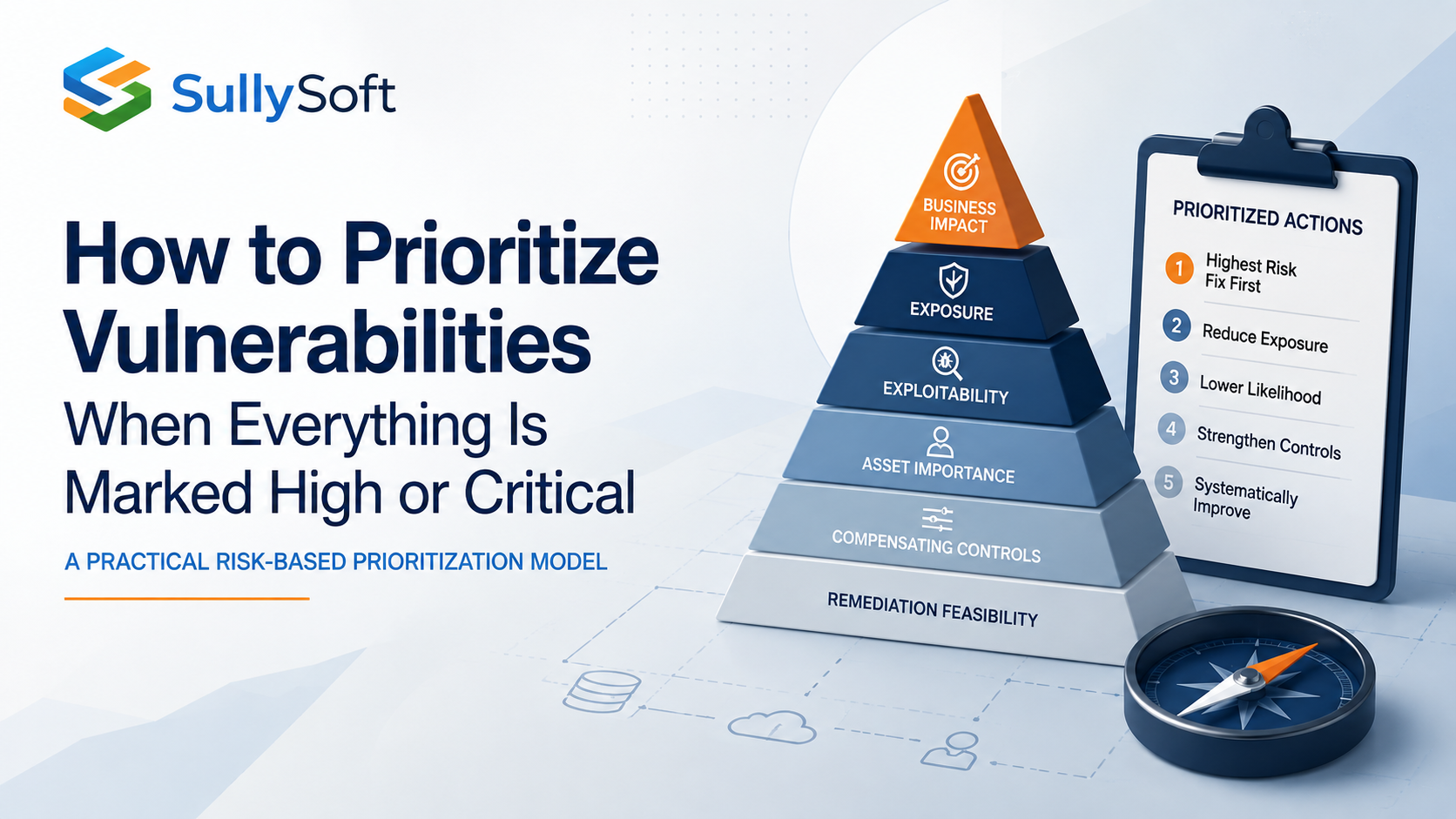
When everything is labeled high or critical, the real question is not “which scanner score is larger?” It is “which exploitable conditions create the most urgent business risk if we do nothing this week?” A practical prioritization model should consider exposure, asset criticality, exploitability, identity privilege, sensitive data, compensating controls, and remediation feasibility. Severity still matters, but it should not decide the queue on its own.
Who this applies to
This guidance applies to teams managing infrastructure vulnerabilities, cloud misconfigurations, identity weaknesses, application findings, exposed services, and other exploitable conditions. It is especially relevant for lean teams receiving findings from multiple scanners and platforms without a shared decision model.
Why severity alone fails in the real world
Scanner severity does not know your business context. It does not know whether the affected asset is internet-facing, whether the vulnerable component is reachable, whether exploitation is already occurring in the wild, or whether a compensating control reduces practical risk.
That is why severity-only programs often create two bad habits:
- Teams chase the loudest number rather than the most relevant risk.
- Leadership receives remediation metrics that look active but do not explain whether exposure is actually going down.
Start by defining what counts as a vulnerability
A useful program should adopt a broad definition. Vulnerabilities are not only CVEs. They also include exploitable cloud configurations, over-privileged identities, exposed management interfaces, missing segmentation, insecure application behavior, risky third-party integrations, and weaknesses in deployment or access controls.
This broader view matters because attackers do not care which internal team produced the weakness. They care whether the condition is exploitable and valuable.
Asset criticality should materially change the queue
A vulnerability on a development sandbox and the same vulnerability on a production identity provider should not be treated as equivalent. Every prioritization model should classify systems by business importance, operational dependency, and blast radius.
Questions to ask include:
- Does the asset support revenue, customer operations, security administration, or core communications?
- Would compromise disrupt a high-value business process?
- Would exploitation create privileged access to other systems?
If the answer is yes, the item should rise faster in the queue.
Internet exposure changes urgency quickly
Direct internet exposure usually increases urgency because the attacker does not need an internal foothold first. That applies to public applications, exposed VPN or remote-management services, cloud storage with broad access, misconfigured identity endpoints, and accessible administrative interfaces.
Not every exposed finding becomes an emergency, but the model should treat exposure as a multiplier, not a footnote.
Exploitability and known exploitation need separate consideration
Exploitability is not the same as theoretical severity. A condition that is easy to exploit, widely weaponized, or already being used in active campaigns should move up the list even if other items have comparable scanner scores.
Known exploitation should be a distinct factor in reporting. Executives may not need exploit details, but they do need to understand that some backlog items are tied to active attacker behavior rather than abstract technical debt.
The Equifax breach is a useful lesson in prioritization
The 2017 Equifax breach is a useful example. Attackers exploited a known critical vulnerability, Apache Struts CVE-2017-5638, ultimately exposing sensitive personal information belonging to approximately 147 million people. The vulnerable application was part of Equifax’s internet-facing dispute portal, and subsequent investigations found that gaps in asset inventory contributed to the vulnerable system not being identified and patched.
After a breach like this makes headlines, a familiar question often comes from leadership: “Could this happen to us?” That can quickly turn into an organization-wide effort to find and eliminate every instance of the vulnerability involved in the breach.
Finding every instance is absolutely the right thing to do. Treating every instance as equally urgent is not.
An internet-facing vulnerable application handling sensitive information should clearly rise to the top of the remediation queue. The same vulnerability on an isolated internal development system with limited access, no sensitive data, and strong compensating controls may still need to be fixed, but it does not necessarily deserve the same immediate priority.
A mature vulnerability management program should be able to identify all affected systems, rapidly remediate the instances creating the greatest business risk, and then work through the remaining exposure according to priority. Otherwise, a high-profile vulnerability can consume the team’s attention while other exploitable conditions presenting greater risk to the organization remain unresolved.
Reachability and execution path matter
Some findings look severe in isolation but are difficult to reach in your environment. Others are attached to exposed attack paths that make exploitation more plausible. The model should account for whether the vulnerable component is actually accessible from the internet, from internal user networks, from partner networks, or only from highly restricted paths.
This is one reason infrastructure, cloud, application, and identity findings should not be triaged in separate silos forever.
Compensating controls should reduce priority when they actually work
Compensating controls are real only if they are enabled, monitored, and relevant to the attack path. Network restrictions, strong segmentation, endpoint protection, workload isolation, privileged access controls, or WAF rules may reduce urgency. They may also be overestimated.
The right question is not “do we own a control that sounds related?” It is “would this control materially slow or prevent exploitation for this specific condition?”
Identity privilege and sensitive data increase impact
If exploitation yields privileged identity access, administrative tokens, or access to sensitive business data, the finding deserves extra weight. A medium-complexity weakness that opens a path to finance systems or privileged cloud administration may matter more than a technically severe issue on an isolated non-critical host.
This is where identity and data context should be present in the same conversation as infrastructure remediation.
Business process impact belongs in the scoring conversation
A practical prioritization model should explain what happens if the weakness is exploited:
- Service disruption.
- Financial process abuse.
- Data exposure.
- Administrative takeover.
- Loss of visibility or response capability.
Those impact statements make prioritization explainable to leadership, not just to engineers.
Vulnerability age and remediation feasibility matter too
Old findings with no owner often indicate structural weakness in the process. A younger but easy-to-remediate finding on a critical exposed system may still outrank them, but age should not disappear from the model. Likewise, remediation feasibility matters. If a fix can be applied quickly and materially reduces risk, that is useful information when sequencing work.
Feasibility should not excuse inaction forever. It should help build a realistic queue that balances fast wins and hard constraints.
Exception handling and risk acceptance need explicit rules
If the organization cannot remediate something quickly, it still needs a decision path. Exception handling should record the business reason, compensating controls, review date, and accountable owner. Risk acceptance should be deliberate and time-bound, not the default outcome for difficult items.
Without this discipline, “accepted risk” becomes another name for unowned backlog.
Build an explainable model instead of a mysterious score
An effective prioritization model does not need to be mathematically complex. It needs to be consistent and defensible. One simple pattern is to score a finding across exposure, exploitability, impact, privilege, data sensitivity, and control coverage, then group the outputs into action bands such as:
- Immediate action.
- This sprint.
- This month.
- Planned remediation.
- Approved exception with review date.
This gives technical teams a queue and gives leadership a framework they can understand.
Report differently to technical and executive audiences
Technical audiences need the specifics: affected assets, attack path, remediation owner, workaround, and due date. Executive audiences need concentration risk, trends, blocked items, and what the organization is doing about the highest-impact exposures.
If both groups receive the same scanner export, neither group is being served well.
Recommended next step
Before buying another scanning tool or tuning another dashboard, define the decision model your team will actually use. That model should span infrastructure, cloud, identity, and application findings so the queue reflects attacker reality rather than internal ownership boundaries.
Relevant SullySoft CTA
If you need help creating a vulnerability prioritization model, remediation workflow, and reporting approach that technical teams and executives can both use, start with the Vulnerability Management Program Starter.
Sources and references
About the author

Mike Sullivan
Mike Sullivan leads SullySoft engagements across cybersecurity, cloud architecture, automation, and secure software delivery.
Relevant next step
Move from article advice to a scoped recommendation
Use this article as a starting point, then map the recommendations to your environment, constraints, and priorities.